History and Origins of Japanese Sumo Wrestling
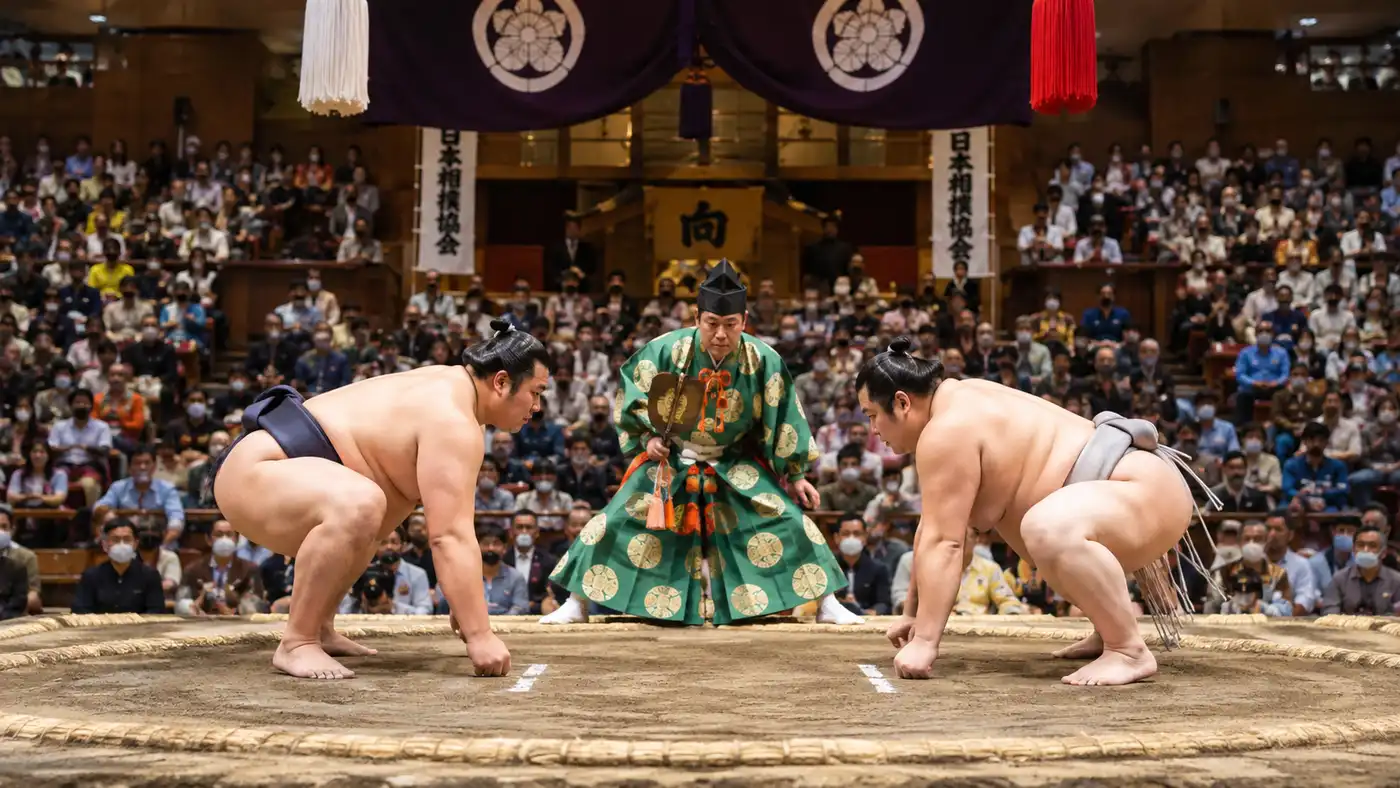
I still remember the first time I sat ringside on a thin zabuton cushion at Ryogoku Kokugikan in Tokyo. The smell of sweet bintsuke hair oil hung thick in the warm air, mixing with dust kicked up from the clay ring. Two men, each weighing easily over 300 pounds, stared each other down across white lines, slapped their thighs, and launched forward with a sound like two trucks colliding at full speed. What looked like a brutal, seconds-long brawl was actually a choreography developed across thousands of years. Understanding the deep history of sumo wrestling changes everything about how you watch it. You stop seeing two heavyweights shoving each other out of a circle, and you start seeing an unbroken prayer for a good harvest that has survived wars, fires, and the fall of empires.
Every strange detail in the arena has an explanation rooted in ancient belief. The salt thrown into the air, the roof hanging from the ceiling without any pillars, the referee dressed in court robes from centuries ago - none of it is theatre meant for tourists. It is living history. To make sense of where does sumo wrestling come from, we have to look back past modern sports leagues, past the samurai civil wars, and straight into Japanese mythology.
Book your sumo wrestling kyoto experience:
Mythology, Gods, and the Sumo Origin Story
Ask an elder in Japan where did sumo wrestling originate, and they will probably tell you a myth before they give you a date. The sumo origin is documented in the Kojiki, or "Records of Ancient Matters," which was written down in 712 AD. The story goes that two gods, Takemikazuchi and Takeminakata, grappled on the beaches of Izumo along the Sea of Japan. They were fighting for control of the Japanese islands. Takemikazuchi grabbed his rival's arm, turned it into an icicle, then into a sword blade, and threw him down. Takemikazuchi won, the imperial line was established, and ancient sumo was born.
Real human records appear shortly after the myths. The earliest human match mentioned in traditional texts happened during the reign of Emperor Suinin, supposedly around 23 BC, though the dates are murky. Two strongmen, Nomino Sukune and Taima no Kehaya, fought in front of the emperor. Kehaya boasted that he was the strongest man under the heavens. Sukune kicked him in the ribs, stomped on his lower back, and killed him on the spot. It was not a gentle sport back then. Sukune was granted Kehaya's lands, and today he is still revered as the patron ancestor of wrestlers. If you visit Sakurai in Nara Prefecture, you can still walk to a small stone mound said to be Kehaya's tomb. I stumbled upon it on an overcast afternoon, completely alone among rural rice paddies, with just a weathered wooden sign marking where sumo wrestling start legends began.
Pro tip: If you visit Nara, take the local train out to Sakurai station and walk 15 minutes to the Sumo Museum Kehayaza, a tiny municipal hall featuring a full-sized clay ring where you can step directly onto the dirt.
These early contests were not entertainment. They were agricultural divination rituals known as shinji-zumo. Shinto priests arranged matches between strong farmhands to divine the will of the kami (spirits). If a wrestler representing the sea won, fishing would be good; if the wrestler representing the mountains won, the rice harvest would flourish. The gods were believed to be watching, so the violence was sacred.
From Imperial Court Rituals to Ancient Sumo Battles
When did sumo originate as an organized spectacle? For that, look to the eighth century. Emperor Shomu gathered wrestlers from across Japan in 734 AD to perform at the imperial palace in Nara. By the Heian period, these gatherings had turned into an annual festival called sechie-zumo, held every seventh lunar month. Court nobles in silk robes sat drinking sake while brutal bouts played out on gravel courtyards. There were no rings back then. Matches had few restrictions: eye gouging and hair pulling were banned, but kicks, open-hand slaps, and neck throws were fair game.
Then the emperors lost power. Around 1185, Minamoto no Yoritomo established the first shogunate in Kamakura, and courtly sumo withered away overnight. The warriors did not care about poetry or elegant harvest rites, but they loved combat efficiency. Ancient sumo was adapted into bushi-zumo, a bare-handed training method for samurai who lost their swords in battle. You learn a lot about how did sumo wrestling start evolving when you look at medieval battle armor. Wrestlers practiced grappling maneuvers meant to twist an opponent down while wearing heavy iron plates. Many techniques found in our guide to classic rules and ringside scoring survive directly from those battlefield survivals.
During the Sengoku period - the chaotic century of civil war in the 1500s - warlord Oda Nobunaga became sumo's biggest celebrity fan. Nobunaga was obsessed with the bouts. In 1578, he held a massive competition at his castle in Azuchi, bringing together roughly 1,500 wrestlers from all over the country. He rewarded the victors with fans, silver, clothes, and even land grants. Because hundreds of fights had to happen in a single day, Nobunaga's attendants drew circular boundaries on the ground so wrestlers wouldn't waste time chasing each other across the fields. That simple ring was the direct ancestor of today's dohyo.
Samurai, Street Fights, and the Changing History of Sumo Wrestling
When peace finally arrived under the Tokugawa shogunate in 1603, masterless samurai (ronin) flooded cities like Edo (Tokyo), Osaka, and Kyoto. Many had no trade other than violence. They set up crude rings on street corners, challenging passersby or each other for small copper coins. These bouts, called tsuji-zumo, often degenerated into drunken riots and sword fights. The authorities cracked down hard. In 1648, the shogunate banned sumo outright across Edo to keep public order.
Sumo survived by dressing itself back up in its holy robes. Shinto shrines and Buddhist temples were constantly burning down in Edo's frequent fires, and rebuilding required massive amounts of money. Temple priests asked the government for special permission to hold charity matches called kanjin-zumo on sacred grounds. The shogunate relented, provided the organizers followed strict rules to prevent violence. The wild street fight had to become a formal performance again.
Between 1684 and the late 1700s, traditional sumo wrestling took the exact shape we see on television today. Promoters established permanent stables, developed professional rankings, and set down 48 legal winning moves. The round ring made of half-buried straw bales filled with packed clay was introduced in 1731. Wrestlers stopped fighting in simple loincloths and began wearing the thick, silk mawashi belts. By the mid-Edo period, legendary champions like Tanikaze and Raiden were household names, revered by commoners and painted by famous woodblock artists like ukiyo-e master Katsukawa Shunsho.
| Historical Era | Approximate Dates | Primary Purpose | Defining Feature |
|---|---|---|---|
| Mythic & Nara | Pre-700s – 794 AD | Shinto harvest divination | No ring; bouts fought to submission or death |
| Heian Period | 794 – 1185 AD | Imperial court festival (sechie) | Refined court entertainment; nationwide scouts |
| Kamakura & Muromachi | 1185 – 1573 AD | Samurai military training | Practical battlefield grappling; ringless combat |
| Edo Period | 1603 – 1867 AD | Temple fundraising & urban sport | Straw ring created; ranks and rules formalized |
| Modern Era | 1868 – Present | National cultural sport | Stable system; six annual grand tournaments |
Note: Women's sumo also has deep roots in temple fundraising matches during the Edo era, though professional grand sumo under the Japan Sumo Association remains strictly male-only due to traditional purity taboos.
Book your sumo wrestling kyoto experience:
Sacred Shinto Rites and Enduring Sumo Wrestling Traditions
When you ask how old is sumo, the answer depends on whether you mean the sport or the ritual. The physical contest takes five seconds, but the ritual takes minutes. Before any professional tournament begins, the clay ring is built entirely from scratch using three truckloads of special clay from the Arakawa River in Saitama Prefecture. In the center of the ring, officials bury six sacred offerings: chestnuts, salt, dried squid, washed rice, kelp, and kaya seeds. These are gifts to the gods, asking for safety and good fortune during the fifteen days of fighting.
You cannot step into a sumo ring with shoes on. Even modern politicians and medical personnel have sparked bitter public arguments by stepping onto the clay. The soil is treated as consecrated ground, equivalent to the inner sanctuary of a shrine. Look upward, and the connection is obvious. Suspended high above the dirt hangs a massive roof built in the traditional shinmei-zukuri style, identical to the roof of the Grand Shrine of Ise, the holiest Shinto shrine in Japan. The four colored tassels hanging from the eaves represent the four seasons and four directional spirits: black for northern winter, blue for eastern spring, red for southern summer, and white for western autumn.
Sumo wrestling traditions dictate almost every action of the fighters before they clash:
- Salt purification (shio-maki): Wrestlers scatter handfuls of coarse salt across the clay to cleanse the ring of malicious spirits before entering.
- Leg stomping (shiko): Raising each leg high in the air and driving the sole into the dirt stamps evil forces deep into the ground.
- Water of power (chikara-mizu): Fighters rinse their mouths with ladled water offered by the preceding winner to purify the body before battle.
- Palm display (chiri-choushu): Rubbing hands together and extending open palms to show opponents that no hidden daggers or weapons are carried into the sacred circle.
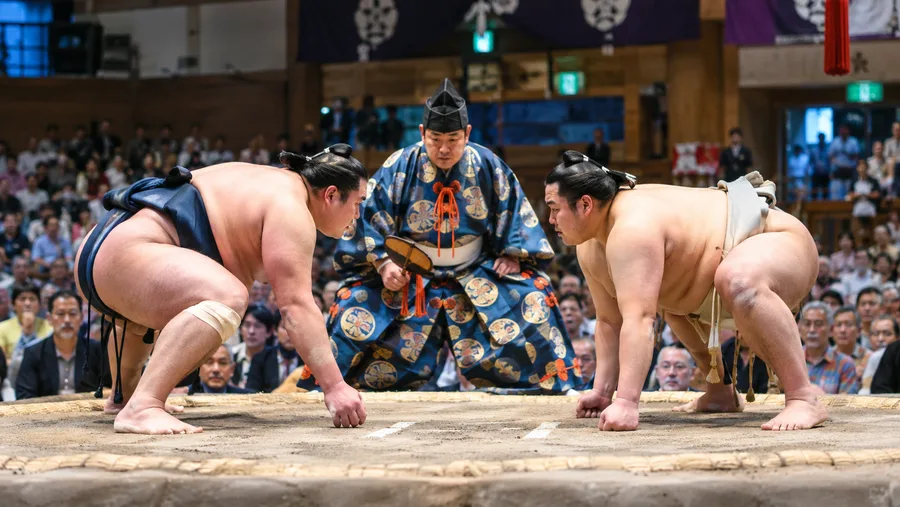
The referee, called the gyoji, carries a wooden fan called a gunbai and wears silk robes patterned after medieval aristocrats. At the highest rank, the head referee carries a dagger tucked inside his waistband. In past centuries, if he made an incorrect judgment call during a championship match, the dagger was there for him to commit ritual suicide. Today, referees no longer commit seppuku, obviously, but they still submit formal resignation letters if they blow a major decision.
Modern Evolution in the History of Sumo Wrestling
Sumo almost vanished during the late 1800s. After Japan opened its borders to the West during the Meiji Restoration, leaders wanted to prove the country was civilized. Western-minded reformers considered topless men slamming into each other in dirt rings embarrassing and barbaric. In 1873, there was serious talk of outlawing the sport completely. What saved sumo was an exhibition match organized for Emperor Meiji himself in 1884. The emperor thoroughly enjoyed the spectacle, declared it a national treasure, and the sport was preserved under state patronage.
The 20th century transformed sumo from a loose confederation of touring troupes into a disciplined, corporate system. The Tokyo Kokugikan was built in 1909, giving the sport its first permanent indoor home. Radios began broadcasting bouts in 1928, which forced promoters to introduce a strict time limit on pre-match staredowns. Television followed in 1953, introducing slow-motion replays that added pressure on the referees. Today, wrestlers live cloistered lives inside roughly 40 residential training stables, following strict hierarchies outlined in our breakdown of ranks and daily training.
If you want to trace this sumo wrestler history with your own feet while traveling in Tokyo, the Ryogoku neighborhood is where you need to spend an afternoon:
- Ryogoku Kokugikan: The primary arena hosting three of the six annual basho tournaments, featuring a free museum on the ground floor with antique ranking scrolls.
- Ekoin Temple: Just a five-minute walk south of the arena, this temple hosted official fundraising matches for over a century and has a giant stone monument dedicated to departed wrestlers.
- Chanko nabe restaurants: Traditional eateries scattered across the backstreets run by retired stablemasters, serving the calorie-dense chicken and cabbage stew that built generations of champions.
- Sumida stable walks: Walking quietly through the residential alleys of Midori and Kamezawa between 7:30 and 9:30 AM lets you hear the dull thud of bodies hitting dirt through open stable windows.
I usually spend an hour sitting outside the Ekoin gate whenever I visit Tokyo. Delivery bicycles cruise by, office workers rush to the subway, and every ten minutes, a massive man in a silk kimono and topknot peddles past on an oversized bicycle with wooden geta sandals clicking against the pedals. It feels like an alternate timeline that refused to disappear.
Frequently Asked Questions about history of sumo wrestling
When was sumo wrestling invented?
Sumo was not invented by a single person at a specific moment. Mythological origins date back to 712 AD in ancient Shinto chronicles, while organized human matches were first recorded at the imperial court in 734 AD. The professional rules, clay ring, and stable system used today were developed during the Edo period around the late 1600s.
Where did sumo wrestlers originate?
Originally, ancient wrestlers were farmers, fishermen, and local strongmen summoned to rural Shinto shrines or imperial courts to participate in harvest rituals. During the feudal wars of the 12th to 16th centuries, samurai adapted the grappling methods for armor combat, creating the lineage of professional fighting stables centered around Tokyo and Osaka.
Why do sumo wrestlers throw salt before matches?
Salt has been a primary purifying agent in Shinto rituals for thousands of years. Wrestlers throw handfuls of coarse salt onto the clay to cleanse the ring of negative energy, protect themselves from injury, and maintain the ring as a sacred space for the gods.
How old is sumo compared to other martial arts?
Sumo is Japan's oldest organized sport, with over 1,500 years of documented history. It predates modern Japanese martial arts like judo, aikido, and modern kendo by many centuries, which were developed much later during the late 19th and early 20th centuries.
Quick Reference
- First written mention in 712 AD (Kojiki mythology)
- Court festival origins under Emperor Shomu in 734 AD
- Circular straw ring introduced around 1731
- Six annual official tournaments held across Japan
Book your sumo wrestling kyoto experience:
My Take
Sumo wrestling is often misunderstood by people who see short video clips online. It gets labeled as an oddity or a simple clash of body mass, but treating it like ordinary sports entertainment misses the point entirely. Sumo survived centuries of political upheaval because it is fundamentally a religious ceremony that happens to involve world-class athletes. Next time you see a match, look past the initial collision. Watch the way the wrestlers rinse their mouths, the quiet dignity of the referee's bow, and the salt floating through the arena lights. You are looking at a living tradition that connects modern Tokyo directly to rice farmers praying for rain fifteen hundred years ago.
Read more about sumo wrestling kyoto.